
Black to Play and Win
Published in Chess Puzzles
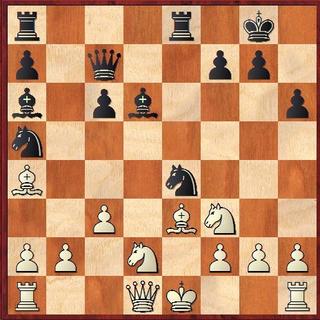
Today is the last of our threesome with one theme. We hope you've figured that theme out! The same idea is here in somewhat more challenging form, but it's here nonetheless. If you need to, review the last two problems, and then take a close look at things that look familiar: a king that can't move, a bishop along the diagonal. How are you going to get that other check to come out of nowhere? Remember the idea of creating the "wish" position, then make moves that help clear the way to realizing your wish. Good luck!
Solution:
This position is from a game between Otago and Wellington, New Zealand, 1926. Walter Korn, who found this game years ago, tells us that this was a telegraph match. It started out with a Two Knights' Defense, which I love! Black sacrifices a pawn to gain time in development and soon most of his pieces are active and threatening. 1.e4 e5 2.Nf3 Nc6 3.Bc4 Nf6 4.Ng5 d5 5.exd5 Na5 6.Bb5+ c6 7.dxc6 bxc6 8.Ba4 h6 9.Nf3 e4 10.Ng1 Bd6 11.d3 0–0 12.dxe4 Nxe4 13.Be3 Ba6 14.Nf3 Qc7 15.Nbd2 Rfe8 16.c3 and now our solution. 16...Nxc3 17.bxc3 The other choice is losing his queen. 17...Rxe3+ 18.fxe3 Bg3+ 19.hxg3 Qxg3# Hopefully, you saw the "wish" check at g3 and asked yourself, "How do I get that check?" If you saw the check possibility at g3 and realized that the rook could take the bishop opening up that g3-e1 diagonal and then realized you had two checks lined up on g3, so you could afford to lose a piece and still end up with a check, then you would ask yourself, as in a previous problem, "How do I get that knight out of the way?" Well, sacrificing it on c3 is great because it is a forcing move—you're threatening the queen. And Rxe3+ is another forcing move. You only leave White here with the choice of losing entirely too much material or getting checkmated. We tried very hard to make this week one big lesson.
From time to time, we'll do this. If you really go through these three problems again, you'll see the usefulness of getting your pieces developed, getting your long range pieces pointing in the direction of your opponent's uncastled and cramped king, and how you go from seeing "wish" positions to making them happen. All three positions were different and the same; however, the pattern—the theme—was the one unified thread that ran through all three. We hope you get a chance to use it! If you do, we'll publish it right here!
Send questions and comments to PTamburro@aol.com.




Comments