
Black to Play
Published in Chess Puzzles
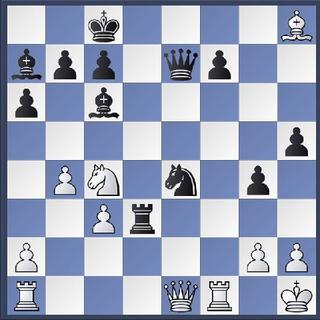
Victor, from Santa Rosa, California wrote to ask if there is a method for solving these puzzles. There are some time tested techniques players use. It's a lot for one column to address, so we'll try over several columns to give you examples. The first thing everyone should think about is the advice the US master Saul Wanetick gave me many years ago: look at all checks, captures and forced moves. That's always the first thing you should do. Scan the position. Look at what every piece can do. Look at the direct threats and the indirect threats. Then judge the position itself. If it's a Black to Play and Win position, ask yourself, "What are White's weaknesses." Look at today's position. What are White's weaknesses? He has no pieces protecting his king in front of the pawn wall. That's a bad sign. The king can't legally move because the Black bishop is attacking g1. He's cornered. Worst of all, it's Black's move! Look at Black's pieces. The rook and knight (who has some checks) are in White's territory. The two bishops are raking the White kingside. The light squared bishop is indirectly pinning the g-pawn. That might be used to Black's advantage. The Black queen can zip over to h4 in one possible maneuver. Look at those three factors again and see if you can put them into some forcing sequence for the most effective attack: checks, captures, forced moves. They're all there! It's a position chock full of possibilities. See how many you find.
Solution:
There are three really good lines here!
1...g3 2.Bf6 Qd7 3.hxg3 Nxg3+ 4.Kh2 Nxf1+ 5.Qxf1 Qg4 6.Bd4 Qh4+ 7.Kg1 Rxd4 8.cxd4 Bxd4+
1...Ng3+ 2.hxg3 [2.Qxg3 Rxg3 3.hxg3 Qe4 4.Rg1 h4 5.gxh4 g3 6.Bf6 Qg4] 2...Qh4+ 3.gxh4 Rh3# (I personally like this the best: it uses checks, captures and forced moves.
1...Rh3 2.Bd4 [2.gxh3 Ng3#] 2...g3 3.Bxa7 Rxh2+ 4.Kg1 Rh1+ 5.Kxh1 Qh4+ 6.Kg1 Qh2#
Note how all those themes appear in every line. Another big thing to notice is the idea of the indirect threat. That bishop attacking the g2 pawn and the Kh1 figures in several of the lines. Also, notice how the queen in one fell swoop can enter the game with dramatic effect, but usually the minor pieces lay the groundwork. Sometimes novices don’t see the “long moves” of chess. All of this relied on the king being cornered and his not being attended to by his own pieces.
Send questions and comments to PTamburro@aol.com.



Comments