
White to Play
Published in Chess Puzzles
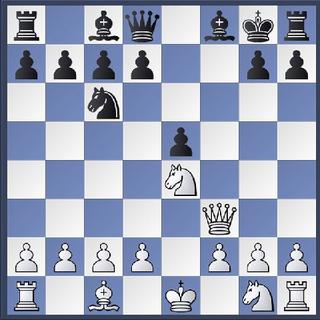
You got a chance to see an old opening trap last time out. Here is one of the oldest, which also appears in a variety of forms. You need to know it as Black and White. This one is a bit different than the usual trap, known as the Fork Trick, which goes like this: 1.e4 e5 2.Nf3 Nc6 3.Bc4 Nf6 4.Nc3 Nxe4! and now, after 6.Nxe4 d5, Black gets his piece back with a free game. Sometimes, White gets tricky with 5.Bxf7+ Kxf7 6.Nxe4 after which Black has to play 6…d5 with a fine game, as after 7.Neg5+ Kg8 works well and after 7.Nfg5+ Ke8 is good. Black’s control of the center is key. Our position was arrived at by means of a somewhat different route: 1.e4 e5 2.Bc4 Nf6 3.Nc3 Nxe4 4.Bxf7+ [Best is 4.Qh5 Nd6 5.Bb3 Nc6 with a complicated game] 4...Kxf7 5.Nxe4 Nc6 [Best is 5...d5] 6.Qf3+ Kg8 [Best is 6...Ke8]. In this case, you are White. What’s your best move here?
Solution:
1.Ng5, which threatens mate on f7. Black’s only defense is a queen move to e7 or e8, after which 2.Qd5+ (or 2.Qb3+) brings about a mate or win of the queen if Black tries 2…Qe5 3.Nxe6. The idea is the weakness of the a2-g8 diagonal. If you check this against the discussion of the other line above, you will note when White played 7.Nfg5+ in that one line, the Black king went to e8 to avoid just the thing that happened here because he noticed that when the knight vacated the f3 square, it meant White could then play his Qf3, so Ke8 becomes a little safer than Kg8. As you can see, a lot of thought can go into the first few moves of a chess game, and it’s good to know both sides.
Send questions and comments to PTamburro@aol.com.






Comments