
Black to Play and Win
Published in Chess Puzzles
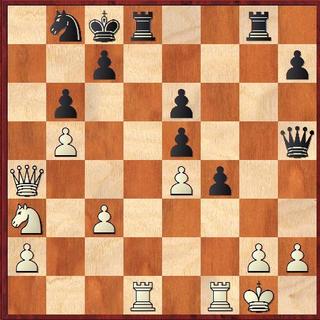
For our Friday festivity, we offer a challenging practical problem. For those of you who have been with us for a while, you know that attacking a castled position usually requires open lines so your pieces can attack the king's position and often requires the sacrifice of a piece, sometimes two or three, to expose the king for the remaining attacking pieces. Of course, on every move, you want to look for checks and captures and forcing moves, as an old master, Sol Wanetick, once told me.
Get your thinking caps on and get to work!
Solution:
1...Rxg2+ 2.Kxg2 [2.Kh1 Qxh2#] 2...Qe2+ 3.Kh3 [3.Kh1 Rd2 4.Rxd2 Qxf1#; 3.Kg1 Rg8+ 4.Kh1 Qg2#; 3.Rf2 Rg8+ 4.Kh1 (4.Kh3 Qg4#) 4...Qxf2 5.Qc2 Qf3+ 6.Qg2 Qxg2#] 3...Rg8 4.Rd8+ Rxd8 5.Qc4 Qh5+ 6.Kg2 Rd2+ 7.Rf2 Qg4+ 8.Kh1 [8.Kf1 Rd1#] 8...Rxf2 and the mate with the queen can only be delayed by useless checks by White. The important concept to remember here is that this is just one way to attack a castled position. There are others, as we've shown here many times before. The more you learn, the better you get! Most chess players do castle to protect their kings. White, here, did not leave sufficient forces around the king to help defend. Black used a sacrifice that forced the king into the open and then used the remaining rook and queen to weave the mating net. You should play through all the variations so you start to recognize patterns and see how good players use their pieces to maximum benefit. Most of us old-timers used to go through those ten position pages of Chess Reviews and try to solve each one to hone our tactical skills. Here, you get three a week instead of ten a month ... a little better, but those puzzles were great, too. This one is picked from a 1955 Chess Review selection by Edward Young.
Send questions and comments to PTamburro@aol.com.






Comments