
White to Play and Win
Published in Chess Puzzles
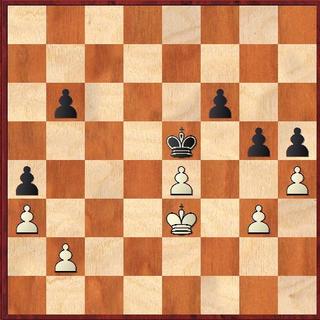
Here we have a game between grandmasters Ree and Ftacnik, played in Kiev in 1978. Frankly, a quick look makes one think that Black has the advantage as his king is placed very strongly; however, Ree spots a flaw in Black's position and takes advantage of it with a superbly played endgame. This is one of those times, dear readers, when you really should take out a chessboard because the solution is worth going through move by move!
Solution:
1.g4 hxg4 [1...gxh4 doesn't work because Black has his own f6 pawn getting in his way: 2.gxh5 h3 3.Kf2 h2 4.Kg2 h1Q+ 5.Kxh1 Ke6 6.Kg2 Kf7 7.Kf3 Kg7 8.Kf4 Kh6 9.Kf5 Kxh5 10.Kxf6 and the king escorts the pawn to promotion.] 2.h5 One of the great rules of endgame play: passed pawns must be pushed. The g-pawn's sacrifice of itself allows this to happen. You can give up pawns, just so your pawn can queen. 2...Ke6 3.Kf2 Kf7 4.Kg3 Kg7 Not really any choice. [4...f5 5.exf5 Kf6 6.Kxg4 b5 7.h6 Kf7 8.Kxg5] 5.Kxg4 Kh6 6.Kf5 Kxh5 7.Kxf6 If you're using the chessboard and pieces to play this out, congratulations! You're going to learn several important lessons. Stop right now, don't look at the rest of the solution and see if you can visualize the next two phases of this endgame. First, you'll notice that, if you count, Black is going to queen first! Why would White allow that? Can you figure that out without peeking? If you solve that little puzzle, then what's your next plan? 7...g4 8.e5 g3 9.e6 g2 10.e7 g1Q 11.e8Q+ Ah! White queens with CHECK! Always put that into your calculation in endgames. It comes up fairly frequently in endgames. But, there's more to it! Do you see it? 11...Kh4 [Bad would be: 11...Kh6 12.Qh8#; and 11...Kg4 12.Qg6+ loses the queen to an "x-ray check." THIS is why White allowed the other player to queen first.] 12.Qh8+ Kg3 13.Qg7+ Kf2 The start of the third stage of this endgame. Should you exchange queens? Yes! White realized (and did when he started this whole thing) that after the queen exchange, his king was closer to the pawns and could gobble them up faster than Black. 14.Qxg1+ Kxg1 15.Ke5 Kf2 16.Kd5 Ke3 17.Kc6 Kd2 18.Kxb6 Kc2 19.Ka5 Kxb2 20.Kxa4 and that's all you need...one little pawn at the end. After 20...Kc3 21.Kb5 opens the highway for the pawn. You should know that if the Black king were on a8 or an adjacent square, the game would be drawn. An epic endgame splendidly played by grandmaster Ree. He teaches us about breakthroughs with pawns, queening with check, x-ray checks and the importance of king position. A free lesson from a grandmaster!
Send questions and comments to PTamburro@aol.com.


Comments